
Stichwörter (Keywords):
- Details
- Category: German culture and food
The Swabians are the people of Württemberg, which is part of the state of Baden-Württemberg in southern Germany. (The folk of the area of Baden are Badisch and their dialect is different.) Each area of Germany has its own characteristics and peculiarities, however since I spent a lot of time there, it's worth spending a bit of time getting to know these hard-working folk. They do not speak what you normally know of as "high German*," but they speak Swabian. It's a dialect far enough removed from Hochdeutsch that many Germans can't understand it.
While I didn't grow up speaking Swabian, I worked with a bunch of them in Stuttgart and picked up a lot of Swabian. I also discovered that I have Swabian ancestry! Des isch aber schee! (Das ist aber schön!)
Swabian is the English translation of "Schwaben." Die Schwaben. A few of their specialties are as follows:
1. Schaffen
Schaffen typically means something is being created, executed, or handled. Not to the Swabians. Schaffen means to work. And work they do. They have a phrase Schaffe, schaffe, Häusle baue: Work, work, build a house. And that's exactly what they do. They are not stereotypically but in reality a very hard-working people and they have a strong infrastructure and stable economy in Baden-Württemberg.
- Hits: 12028
- Details
- Category: German culture and food
 Between 1820 and World War I, nearly six million Germans immigrated to the United States. From 1840 to 1880, they were the largest group of immigrants. Though we had had immigrants from the German states as early as the 1670s, none of the groups were as massive as what was seen in the nineteenth century.
Though Germans were mostly eager to fit into American life, learning English as soon as possible, there was still a preference for German customs, foods, and household goods that reminded them of their homeland.
In the 1920s and 1930s, German manufacturers began exporting earthenware to the United States that had familiar styles to those of German ancestry. Sold in shops across the country, they were inexpensive and colorful. The earliest patterns were derivative of 19th century Persian designs, so the import mark identifies them as Persian Ware – Made in Germany. But the designs varied widely, some looking very modern. What were consistent were the bright colors and bold patterns.
- Hits: 7362
- Details
- Category: German culture and food
It's no secret that Germans have a lot of rules. One "rule" that has become more flexible in the last few years is what you can name your child and how you spell her or his name. Now you can even bypass the commonly-accepted French spelling of the name "Jacqueline" and go right for the German phonetic spelling of "Schaklyn."
Yes, really.
Here is an article about the process of naming your child in Germany and for all you German learners out there, here are a few ways to read this article and expand upon your reading skills based on your level. N.B. I recommend you print the article out and grab a pencil no matter what your level is.
Beginners:
Read the article and look for all the different names that are presented. Circle them. Then comb through the article and look for all the verbs. How many of them do you recognize already?
Intermediate:
Lesen Sie den Artikel.
- Hits: 5744
- Details
- Category: German culture and food
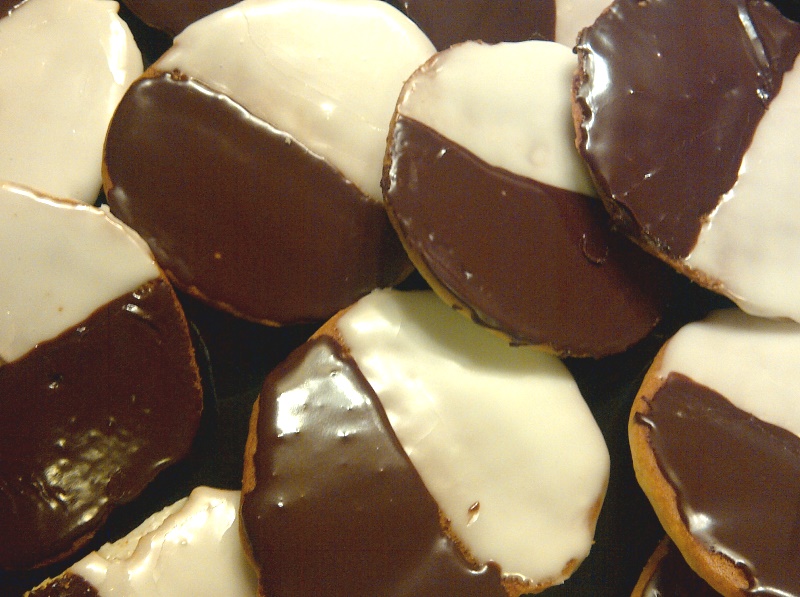
"Amerikaner" means "American" and it is also the name of a most fabulous cake cookie that's available in many locations all over Germany.
They are beautiful, delicious cookies about the size of the palm of your hand and they make a fantastic sweet snack or as part of Kaffee (coffee and cake at 3 p.m. in Germany. What a delicious tradition.)
Here is a recipe for these cookies, known as black-and-white cookies here in the US. I made them for one of my German classes and they loved them. I hope you do, too!
When you bake them, let me know what you think! Leave a comment below.
- Hits: 6702
- Details
- Category: German culture and food
Germans are incredibly direct. A German really will ask you if you've gained weight (Haben Sie zugenommen?), just as someone might ask if you have lost weight at another time (Haben Sie abgenommen?).
Why do they think it's OK to ask such a personal question?
What's disconcerting for people from the States, is that we don't ask this question unless we can tell for certain. For a German on the other hand, this question is simply a matter of fact and by no means a judgement.
Ask any American if s/he has gained weight, and you'll probably get an angry response. Here, that's simply a rude question. Weight is a hot-button issue here, and it's par for the course that someone might ask you if you've lost weight, and then follow it up with a compliment, no matter if your answer is yes or no. But we don't ask if someone has gained weight--in lies in the realm of rudeness.
- Hits: 15293
